

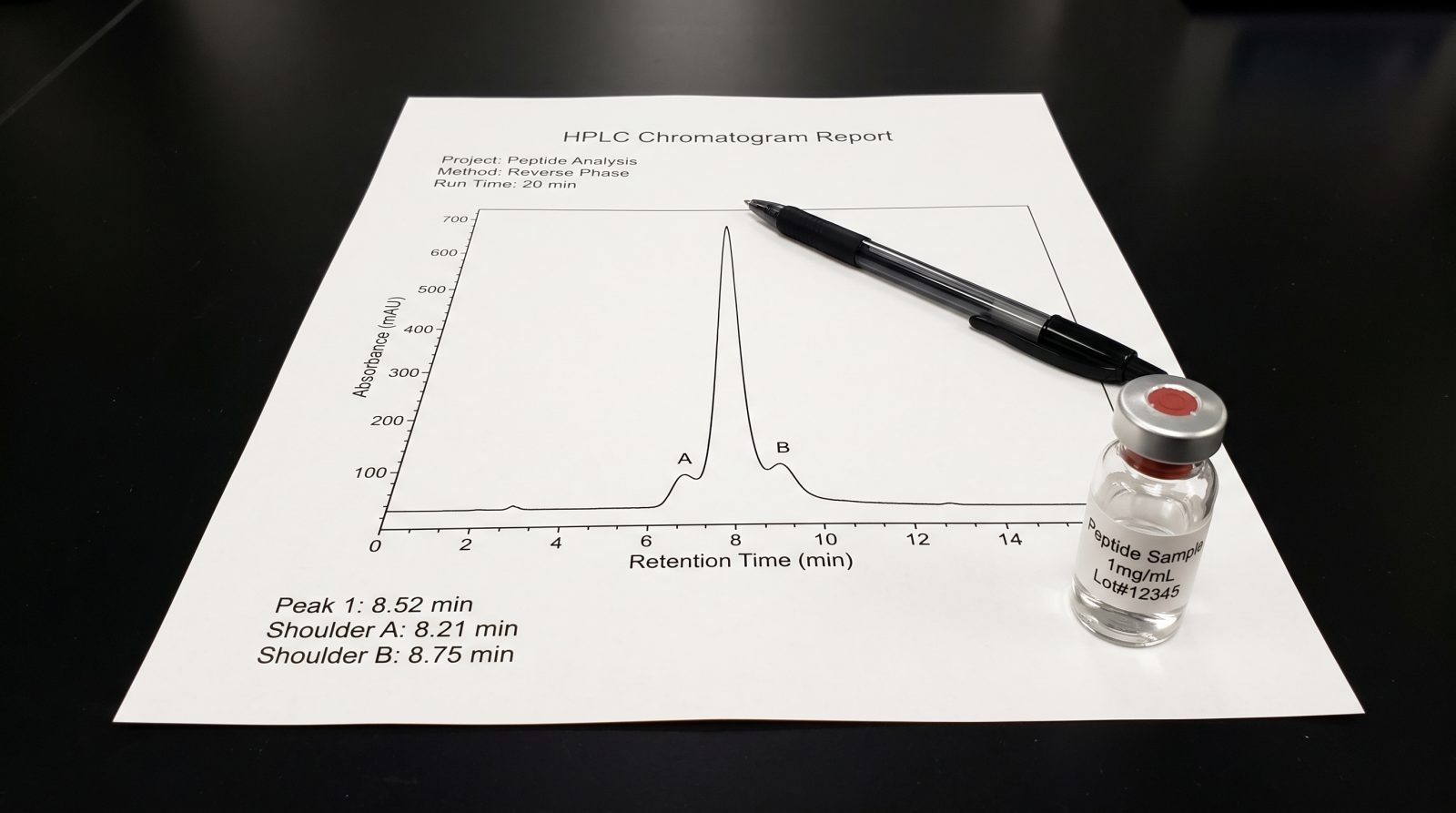
A certificate of analysis is the only objective statement anyone makes about a research peptide. Everything else is a description. Yet most certificates are glanced at for one number, the purity percentage, and filed. This is a guide to the rest of the page: what each line means, what it does and does not prove, and the two lines that deserve more attention than the headline figure.
Everything here concerns laboratory reference materials for in-vitro work.
What the instrument is actually measuring
Peptide purity is almost always reported from reversed-phase high-performance liquid chromatography, RP-HPLC. The sample is dissolved, injected onto a column packed with a hydrophobic stationary phase (typically C18), and pushed through with a solvent gradient that moves from mostly water to mostly acetonitrile, usually with a small amount of trifluoroacetic acid.1 Components separate by how strongly they stick to the column. A UV detector set near 214 to 220 nanometers, where the peptide backbone absorbs, records what elutes and when.1
The output is the chromatogram: a trace of absorbance against time. The peptide of interest is the main peak. Anything else is an impurity, a counter-ion, or the solvent front.
Reading the chromatogram
Retention time is when the main peak elutes, in minutes. On its own it is not identity, because different peptides can share a retention time, but it is a fingerprint under a stated method. A retention time that has moved between batches, under the same method, is a question worth asking.3
Area percent is the purity figure. The software integrates the area under every peak, and the main peak's share of the total is reported as purity. A certificate that reads 99.2 percent is saying that 99.2 percent of the UV-absorbing material that eluted was the main peak.1 Two things follow. First, this is a relative measure: it says how clean the peptide is compared with its own impurities, not how much peptide is in the vial. Second, anything that does not absorb at the detection wavelength, such as water, salts and most counter-ions, is invisible to it.
The small peaks matter. In synthetic peptides the common impurities are deletion sequences (a residue missed during synthesis), truncated chains, and modified forms such as an oxidized methionine (+16 mass units) or a deamidated asparagine.14 A shoulder on the main peak, a peak that has not fully separated, is often one of these near-identical species. A good certificate lists the impurity peaks with their retention times and areas rather than folding them into a single number.
Identity: the line people skip
Purity tells you the sample is mostly one thing. Mass spectrometry tells you what that thing is. The certificate should state the theoretical molecular weight of the sequence and the observed mass, typically from electrospray ionization, often expressed as the protonated ion.4 The two should agree within the instrument's stated tolerance. A purity of 99 percent with no mass confirmation is a clean chromatogram of an unconfirmed compound.
Net peptide content: the number the purity figure is not
A lyophilized peptide is never 100 percent peptide by weight. It carries bound water and counter-ions, most commonly trifluoroacetate from the purification step, and together these can account for a meaningful fraction of the powder's mass.1 Net peptide content, determined by methods such as amino acid analysis or nitrogen determination, states what fraction of the weight is actually peptide. It is a separate line from purity and is often absent from certificates. When it is absent, the mass in the vial is nominal, and any concentration calculated from it is nominal too. Serious in-vitro work accounts for this.
The method line and the lab line
Two lines rarely read: the method (column, gradient, wavelength, flow) and who ran it. Purity figures are only comparable between certificates run under the same method, and an analytical method is only trustworthy when it has been validated for specificity, linearity and precision.2 A certificate issued by an independent laboratory, naming its method, is a different document from one issued by the seller with no method stated, even if the headline number is identical.
Four questions a certificate answers, and one it does not
- How clean is it? Area percent purity, with the impurity peaks listed.
- Is it the right compound? Observed mass against theoretical mass.
- How much peptide is in the vial? Net peptide content, if reported.
- Can I trust the numbers? The method line and the laboratory that ran it.
- Is the vial in my hand the one that was tested? No certificate answers this. Only the batch number does, and only if it is printed on the vial and matches the certificate.
Why every vial we ship carries a batch number
A certificate is tied to a lot, not to a product name. Two vials of the same compound from different lots have different certificates, and the only link between a vial and its certificate is the number printed on it. Every vial from Prime Core Dynamics carries its batch number, and the certificate for that lot is published in the COA library. Read the certificate for the lot, not the product, and read past the headline.
For research use only. Nothing on this page is guidance for human or animal use.